Own Your Position
22 chapters, 16 of them position chapters
Most players never get coached properly at their own position.
This is the position coaching you are probably not getting. 16 position chapters covering every spot on the field, 4 foundation chapters that apply to everybody, and 101 drills, most of them needing only cones, a ball, a wall and a partner.
One PDF. 198 pages. 22 chapters, 16 of them position chapters, each built the same way so you can find what you need and get back to work. Every position chapter has the same 10 sections in the same order, so once you have read one you know where everything lives in all of them.
PDF · Written for players, parents and coaches
Independent instructional guide. Not affiliated with, endorsed by, sponsored by, or licensed by any league, conference, school, or club.
Why this book exists
A high school staff might have four adults and sixty players across eleven positions on offense, eleven on defense, and a special teams unit nobody has time for. The head coach knows the offense. One assistant knows the line because he played there. Everyone else gets the general stuff: run hard, stay low, finish.
All of it is true. All of it is useless when you are standing in a three-point stance wondering what your hands are supposed to do.
What is inside
22 chapters: 16 position chapters, 4 foundation chapters, and two on building a football year and choosing your position.
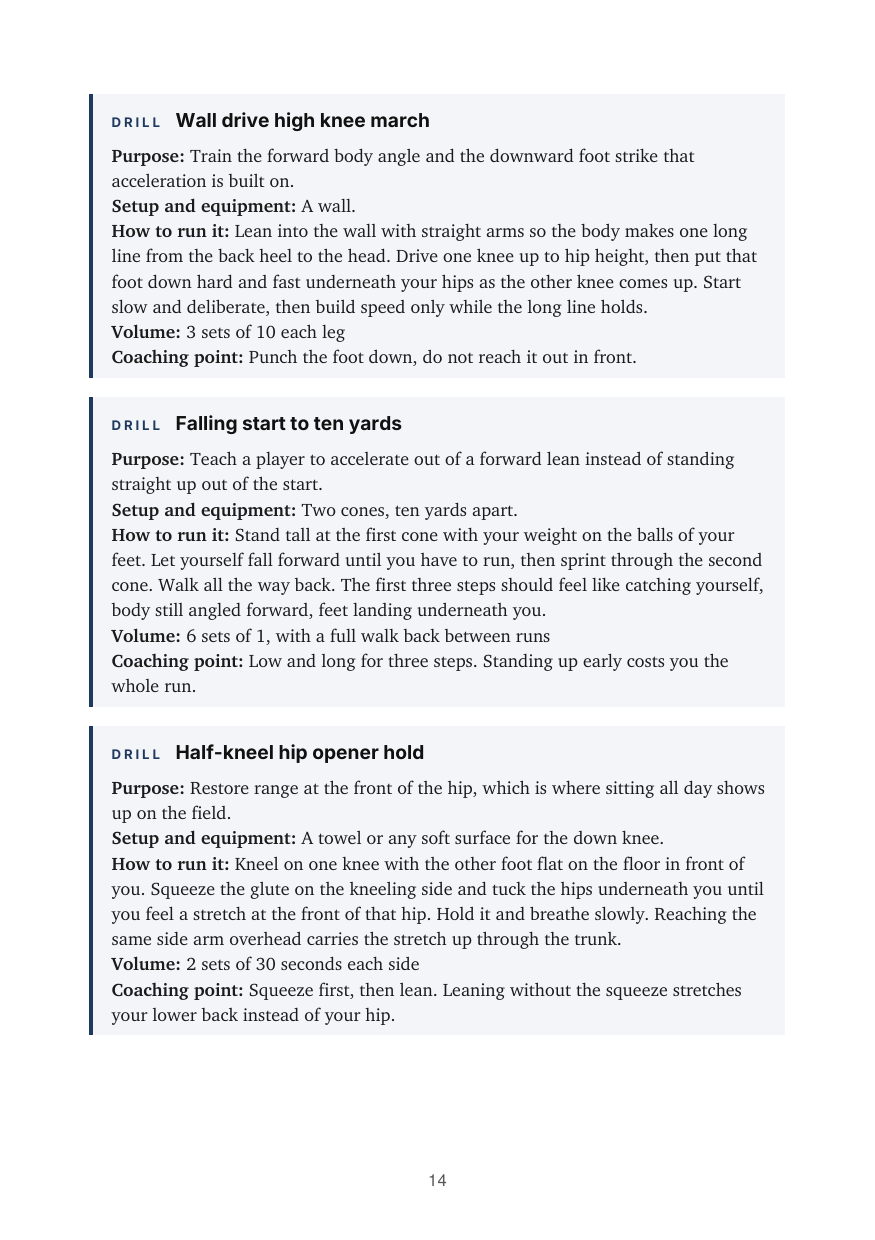
101 drills, each written the same way: purpose, setup and equipment, how to run it, volume, and a coaching point.
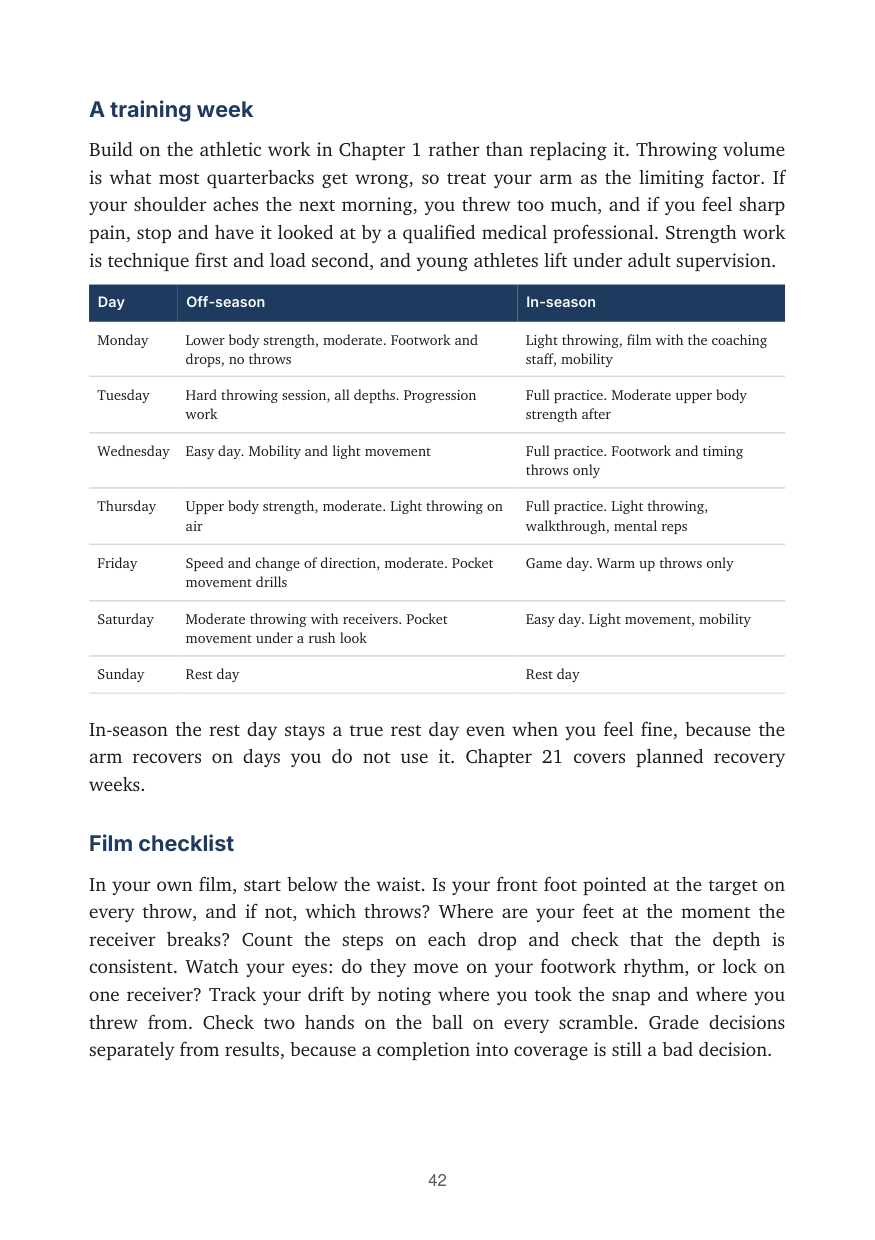
A sample off-season week and a sample in-season week in every position chapter, each with at least one full rest day.
A film checklist in every position chapter, for watching your own film and an opponent's.
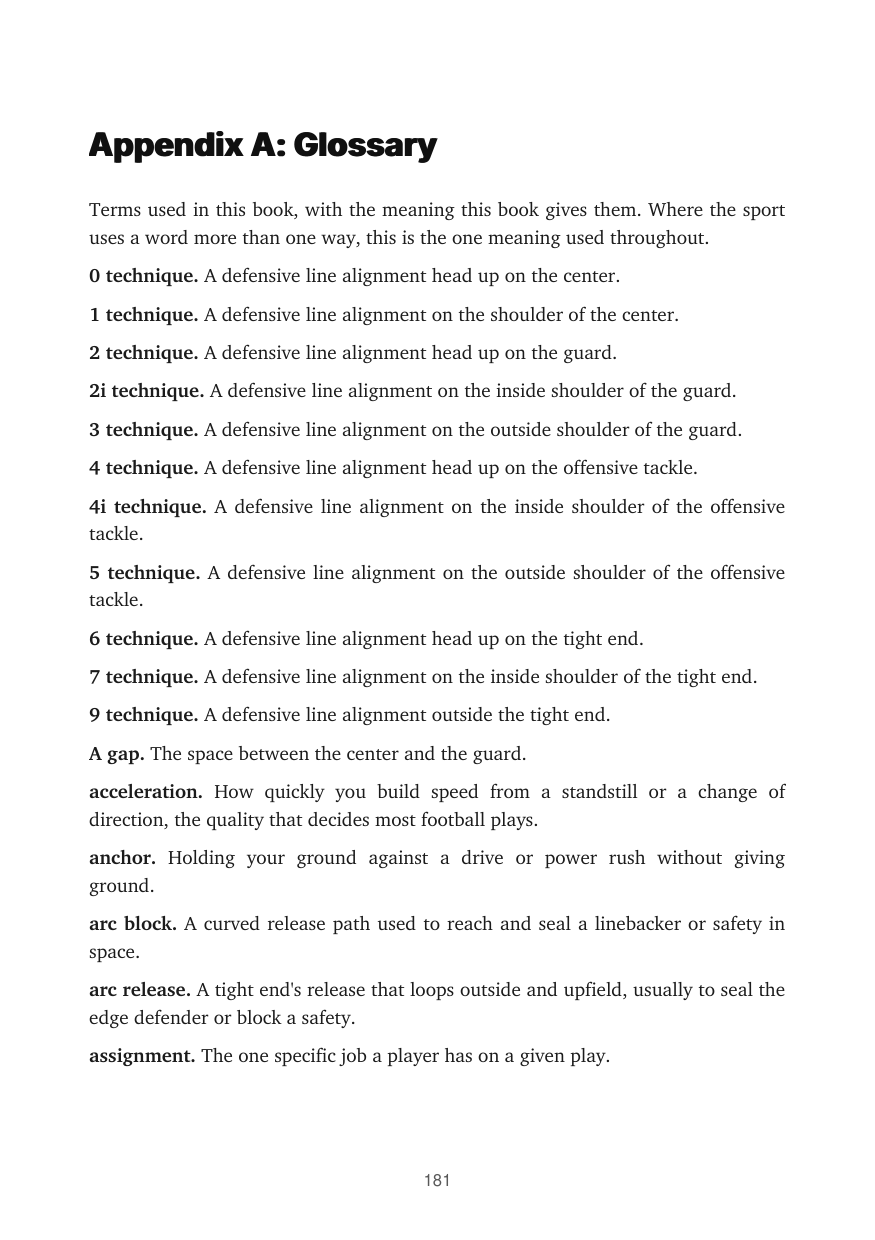
A glossary of 252 terms and an index of every drill by name and chapter.
Contact technique taught heads-up throughout, with a full chapter on injury awareness and concussion signs.
Text and tables. No photographs.
What is in each position chapter
The same 10 sections, in the same order, in all 16 of them. Once you have read one you know where everything lives in the rest.
The job
What the position is actually responsible for, in plain terms.
Body and traits
What the position asks of you physically, and what it does not.
Stance and start
Where the feet, hips and hands go, and the first movement off the ball.
Core techniques
The handful of movements the position is built on, taught in order.
Reads and assignments
What to look at before the snap and what it tells you.
Common mistakes and how to fix them
The errors that show up most, and the correction for each.
Drills
Purpose, setup and equipment, how to run it, volume, and a coaching point.
A training week
An off-season week and an in-season week, each with a full rest day.
Film checklist
What to look for in your own film and in an opponent's.
From beginner to advanced
What to master first, second and third.
That structure is deliberate. It matters when you switch positions, when you play two, or when you want to understand the player across from you. Reading the cornerback chapter is one of the better things a wide receiver can do with an afternoon.
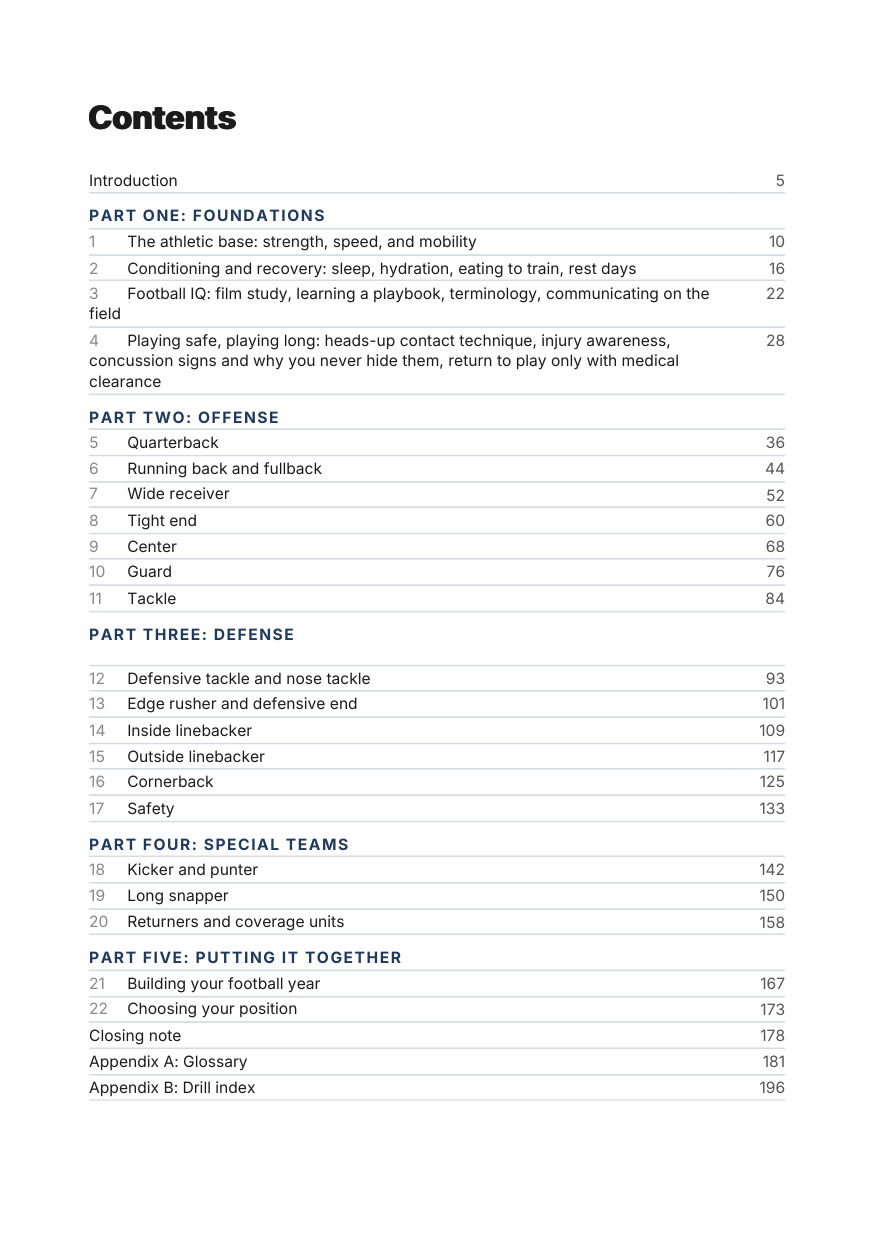
The 22 chapters
- Part One: Foundations
- 1The athletic base: strength, speed, and mobility
- 2Conditioning and recovery: sleep, hydration, eating to train, rest days
- 3Football IQ: film study, learning a playbook, terminology, communicating on the field
- 4Playing safe, playing long: heads-up contact technique, injury awareness, concussion signs and why you never hide them, return to play only with medical clearance
- Part Two: Offense
- 5Quarterback
- 6Running back and fullback
- 7Wide receiver
- 8Tight end
- 9Center
- 10Guard
- 11Tackle
- Part Three: Defense
- 12Defensive tackle and nose tackle
- 13Edge rusher and defensive end
- 14Inside linebacker
- 15Outside linebacker
- 16Cornerback
- 17Safety
- Part Four: Special Teams
- 18Kicker and punter
- 19Long snapper
- 20Returners and coverage units
- Part Five: Putting It Together
- 21Building your football year
- 22Choosing your position
Plus an introduction, a closing note, a glossary and a drill index.
Part One applies to everybody. Read it whatever position you play, because every position chapter assumes you have.
What it looks like
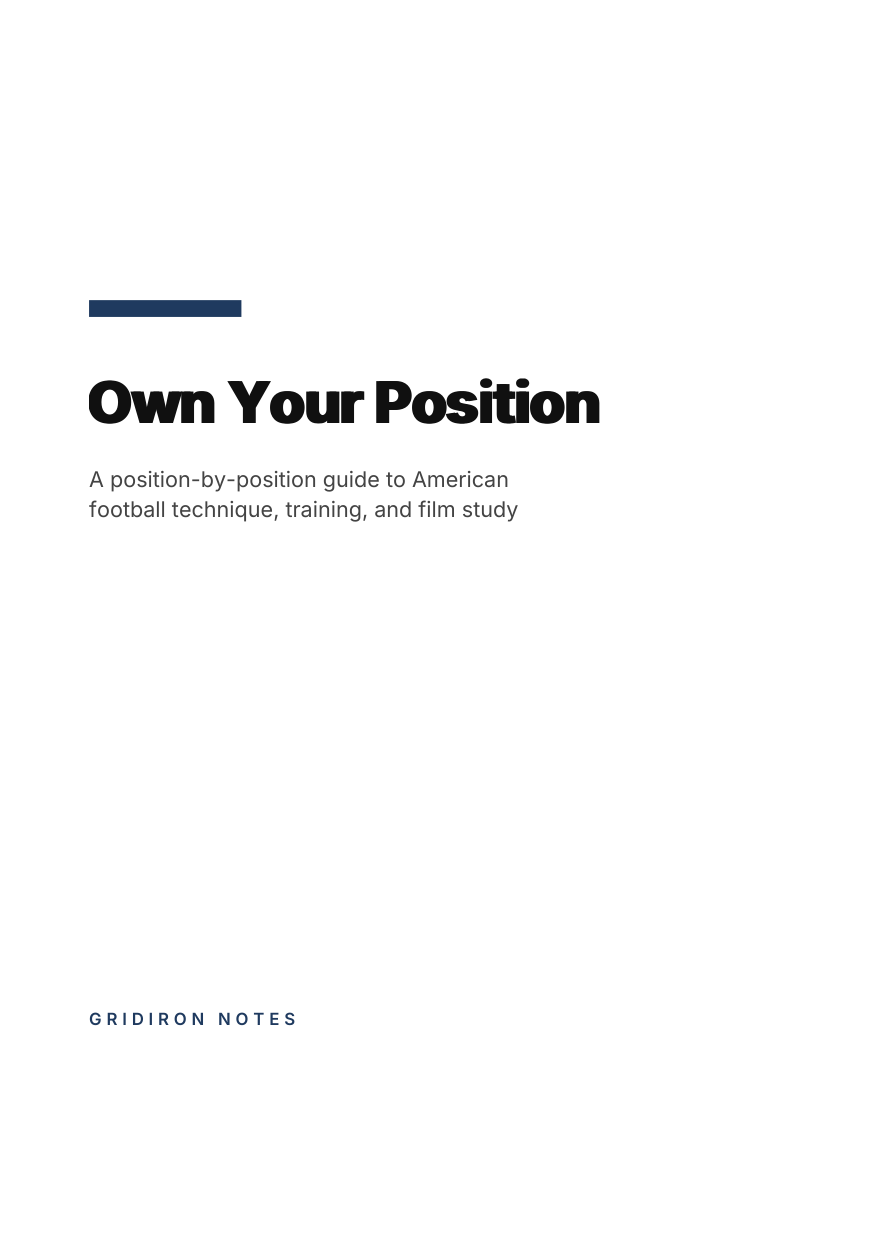
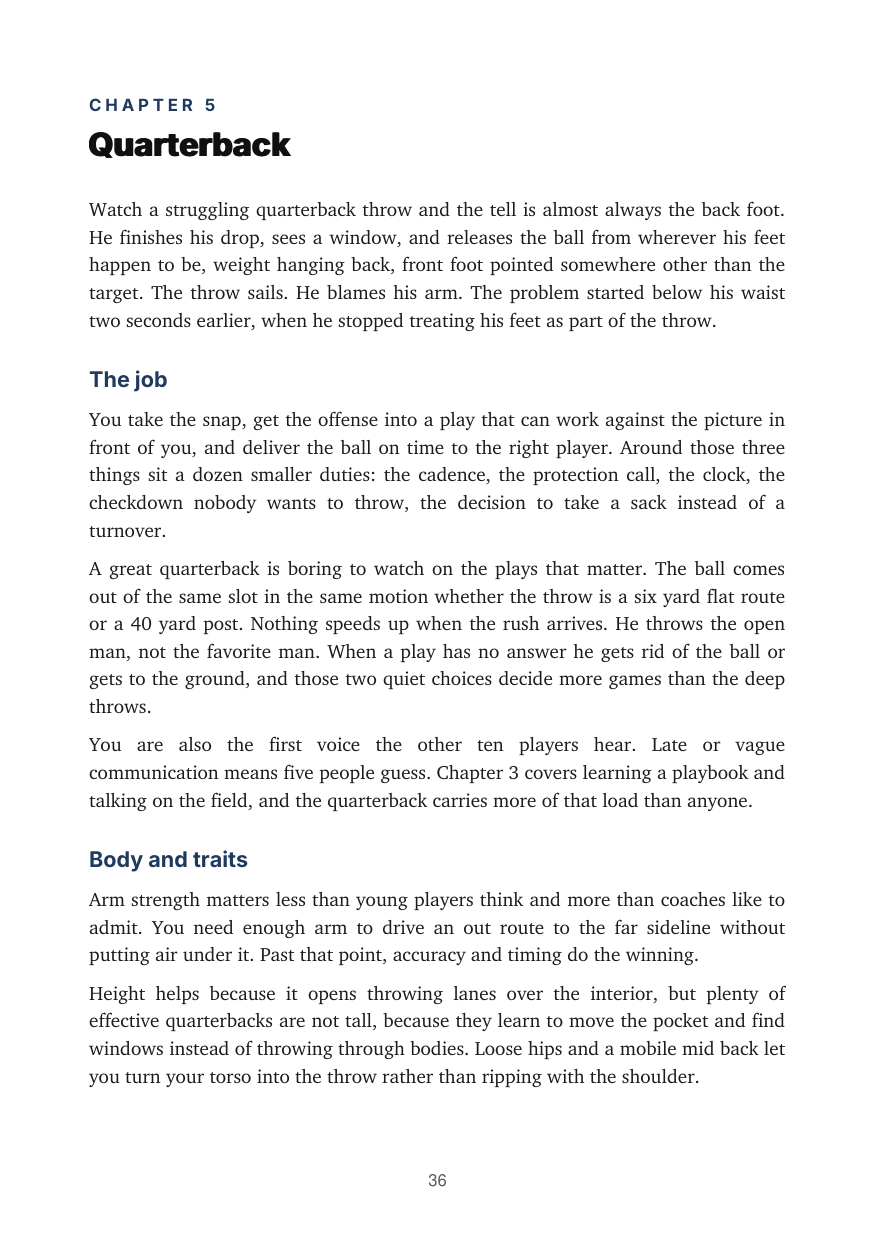
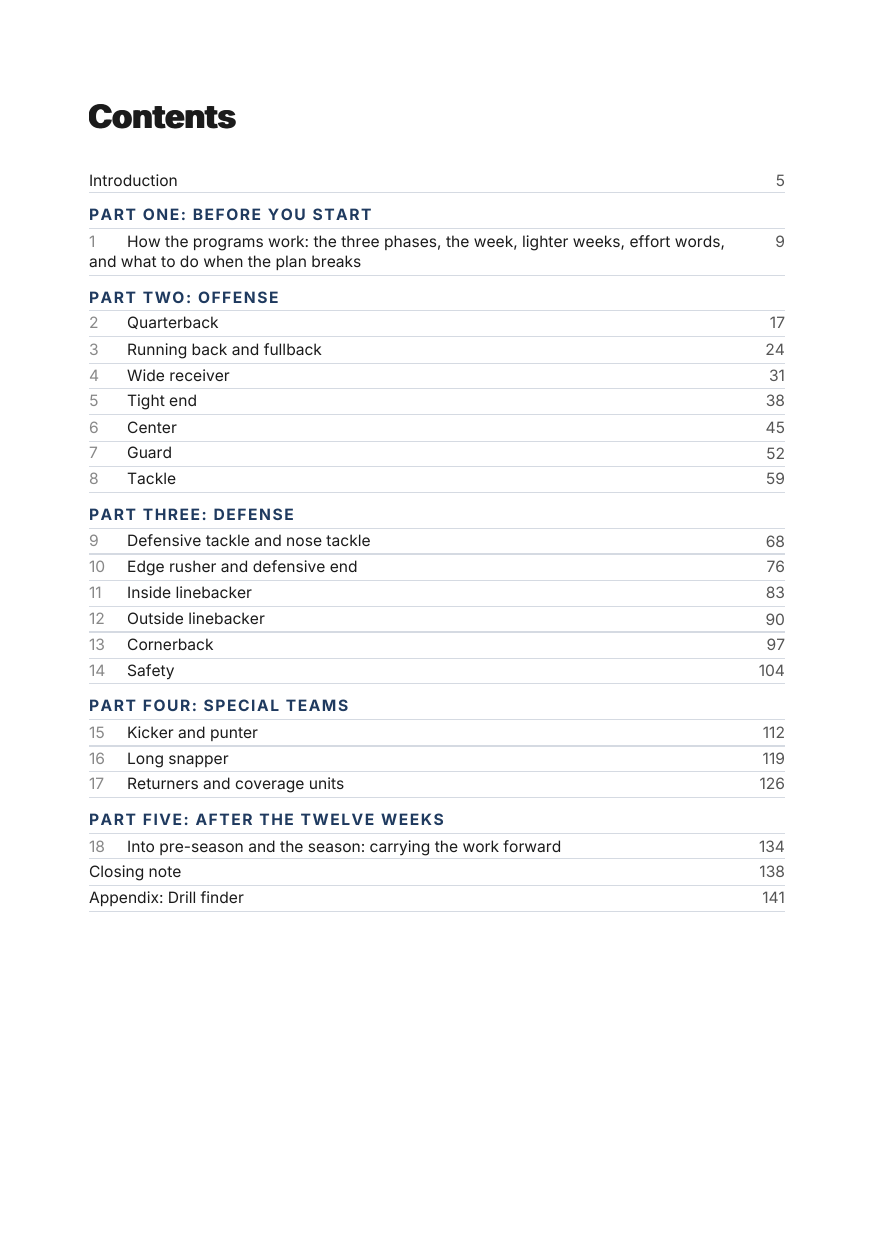
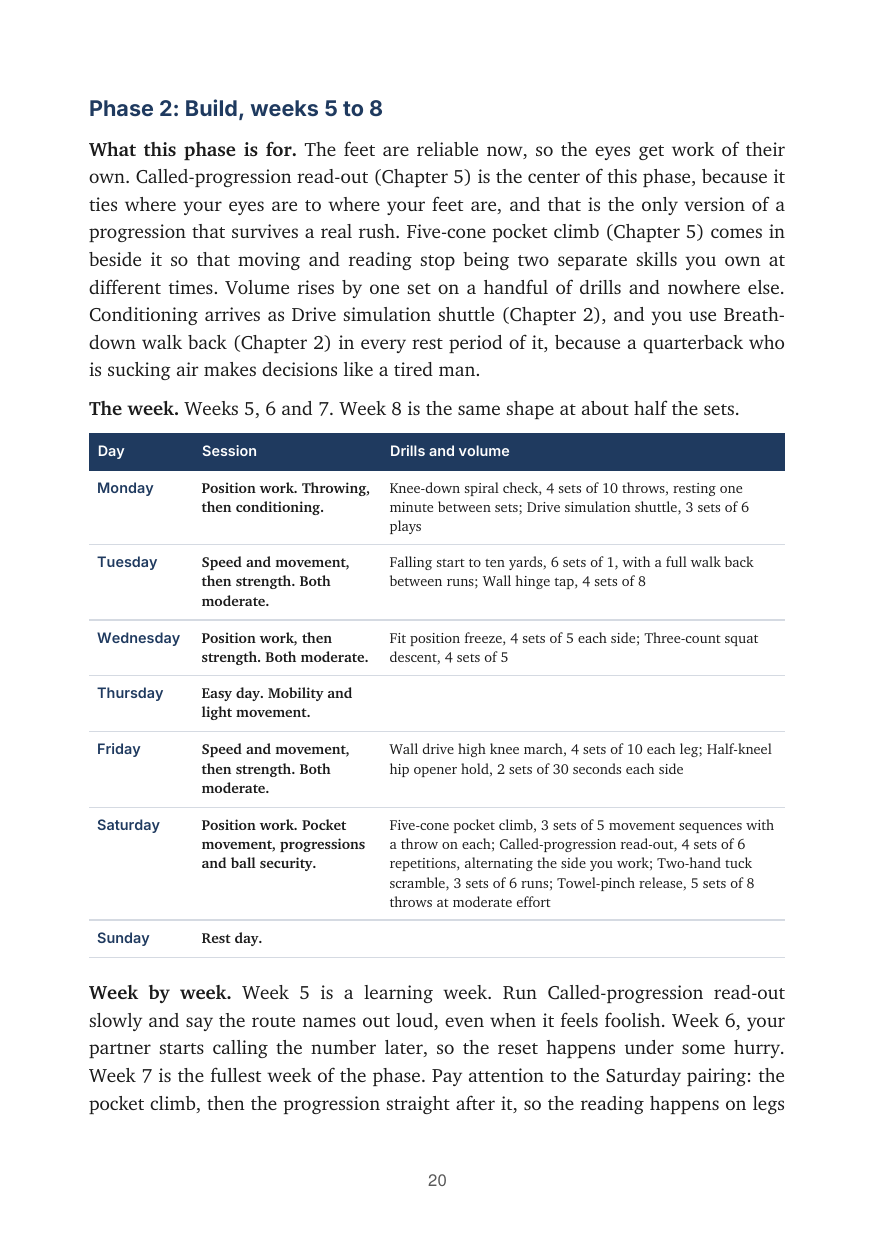
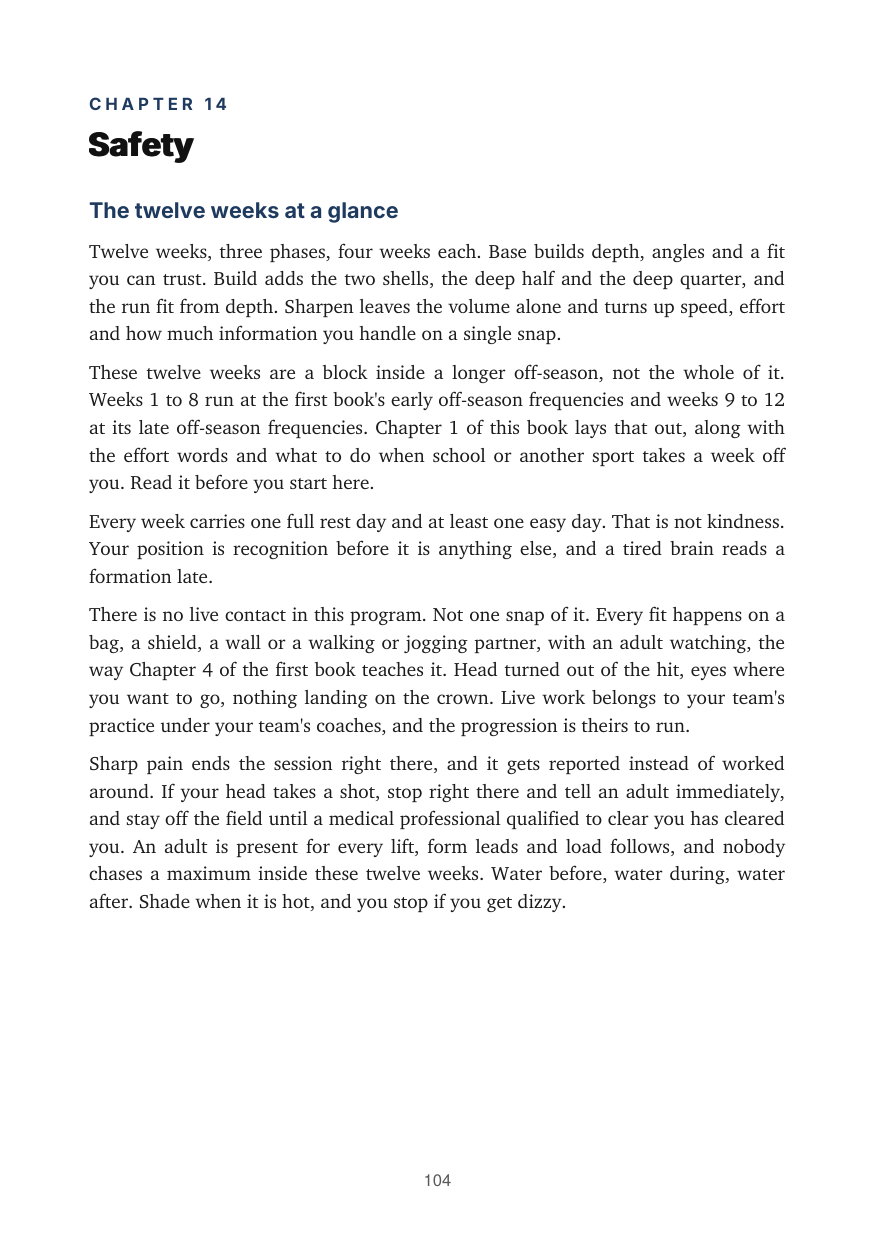
Six pages from the book, exactly as they are delivered.
The 12-Week Programs
Own Your Position tells you what to do. The 12-Week Programs tells you when. It is the companion book: 144 pages that take the 101 drills already in the first book and lay them out day by day.
Sixteen programs, one for each position chapter in Own Your Position. Twelve weeks each. Every program runs in three phases of four weeks: Base, where every drill sits at the volume the first book printed for it, Build, where a drill may pick up one more set, and Sharpen, where the sets stop moving and the speed or the difficulty goes up instead.
Each phase has a week-at-a-glance table, Monday to Sunday: the day, the kind of session, and which drills at what volume. 48 tables in all. Every week has one easy day and one day of rest with nothing on it. Weeks 4, 8 and 12 are lighter weeks, the same drills at about half the sets.
Ready to move on
At the end of every phase, three to five things you, your parent or your coach can see, either with your own eyes or on your film. No times, no weights, nothing to hit. If they are not there yet, you run the phase again.
One film focus a week
A single thing to watch for in your own film that week, taken from your position's film checklist in the first book. Twelve weeks, twelve things, in an order that builds.
A three-day version
Every program has one, for the weeks when three days is what you have.
When the plan breaks
Chapter 1 covers a missed week, exam season, another sport, soreness, pain, a growth spurt. The answer is always less volume rather than more.
Almost no equipment
A ball, a bag or a shield, a wall, some cones, a partner some of the time, a phone to film with. It does not assume a weight room: the strength work is written as patterns rather than named lifts.
No live contact
The contact drills are controlled fits on a bag, a shield, a wall or a walking or jogging partner, with an adult watching.
The programs name a drill and give you its chapter, like this: Fit position freeze (Chapter 4). They do not reprint how to run it. You open Own Your Position for that, which is why The 12-Week Programs is sold only together with the first book and not on its own.
It adds no new drill, no new technique and no new lift, and it promises nothing about where the game takes you. What it gives you is an order of work and a way to check whether it is happening.
Get the book or the bundle
The Glow
Own Your Position
One PDF, 198 pages. 22 chapters, 16 of them position chapters, and 101 drills.
$69.99 USD
One-time purchase. Delivered as a PDF download right after purchase.
The glow
Own Your Position + The 12-Week Programs
Both PDFs. Own Your Position, 198 pages, and The 12-Week Programs, 144 pages, with 16 twelve-week off-season programs built from the first book's drills.
$89.99 USD
One-time purchase. Both PDFs delivered as downloads right after purchase.
Who this is for
If you are a player, this is a manual. Read your chapter, pick two things, work on them for three weeks, then come back for the next two. Nobody improves at ten things at once.
If you are a parent, this will tell you what your kid is actually being asked to do out there, and what good technique looks like, so you can tell the difference between a bad play and a bad habit.
If you are a coach handed a position group you never played, this gives you a teaching progression and a drill list you can run tomorrow.
The writing assumes you know the basics of the game. It does not explain what a down is. It does explain what a three technique is, why a cornerback opens his hips the way he does, and how a long snapper gets a ball to travel fifteen yards backwards and still arrive laces up.
How the drills work
Every drill is written the same way: purpose, setup and equipment, how to run it, volume, and a coaching point.
The equipment list stays cheap. Cones, a ball, a wall, a towel, a partner. If a drill needs a sled or a bag it says so, and there is almost always a version you can run without one.
Volume is written as sets and reps. Those numbers are a starting point for a healthy player, not a prescription. If eight reps of something makes your technique fall apart on rep six, do five good ones. A drill run badly teaches you to do the thing badly, and you will have to unlearn it later.
Effort is described in three words: light, moderate, and hard. You will not find percentages of a one-repetition maximum anywhere in the book. Technique first, then load, and load only moves up when the movement is clean.
On safety
Football is a contact sport. The way you make contact is the single most important technical thing you will learn, and this book teaches one way: heads-up, with your head out of the contact point. Eyes up, chest to the target, head to the side. Never the crown of the helmet.
Chapter 4 covers this in full, along with the signs of a head injury and what to do about them. The short version is that you report symptoms immediately, you never hide them to stay on the field, and you come back only when a qualified medical professional clears you. Every position chapter points back to Chapter 4 on contact, and they do that on purpose.
Nutrition and hydration in the book stay general. Eat enough, eat real food, drink water, eat something after you train. There are no supplements, no dosages, no calorie targets and no weight cutting anywhere in it.
What a book cannot do
A book cannot watch your feet. It cannot tell you that your second step is too long, or that you are standing up out of your stance before the ball moves. That is what coaches and cameras are for, and Chapter 3 is largely about how to use both.
A book also cannot replace repetition. Reading about a punch is not practice. The gap between knowing a technique and owning it is measured in hundreds of repetitions, most of them boring, many of them done alone against a wall in a garage.
What a book can do is tell you what to practice, in what order, and why, so that the hundreds of repetitions go into something that works. That is the whole job of this one.
Questions
Is this connected to any league or club?
No. It is an independent instructional guide. It is not affiliated with, endorsed by, sponsored by, or licensed by any league, conference, school, or club.
What format is it?
PDF, text and tables. Own Your Position on its own is one file of 198 pages. The bundle is two files, 198 pages and 144 pages. You keep them, read them on any device you own, and print them for yourself.
Can I buy The 12-Week Programs on its own?
No. It only comes in the bundle with Own Your Position, because every program is built from the drills in the first book and you open that book to run them.
Do the programs need a gym?
No. They assume a ball, a bag or a shield, a wall, some cones, a partner some of the time, and a phone to film with. The strength work is written as patterns rather than named lifts, so a player with a bar and a rack and a player with a hill and a sandbag can both run the program.
Do I need equipment?
Cones, a ball, a wall, a towel and a partner cover most of the book. Where a drill needs a sled or a bag it says so, and there is almost always a version without one.
Does it cover my position?
There are 16 position chapters, covering offense, defense and special teams, including long snapper and the coverage units. The full list is above.
Is it for beginners or experienced players?
Both. Every position chapter ends with a section called From beginner to advanced that puts the techniques in the order you should learn them.
Where should I start?
If you already know your position, go to your chapter. If you do not know it yet, start with Chapter 22. It will not tell you what you are. It gives you an honest way to think about body, skills and temperament, and the questions to ask your coach.
Is this medical or strength coaching advice?
No. It is general instructional information. Talk to a qualified physician before starting any training program, and train under a qualified coach.